This is the story connecting the individual Gear Arena guides. It is not a claim that every family should follow the same route or that the same evidence will work in every case. I am separating what happened to us from what I think was useful and from the official requirements that control each application.
It started with my father — but the story begins with his mother
My father was born in Germany to an unmarried German mother. His mother had left Sickerode in September 1952, spent about a year in Aachen working as a maid, and eventually settled in Hanau. There she met a U.S. Army soldier and became pregnant with my father.
According to our family history, after my father was born my grandmother was told through the Army that his biological father had been killed in action. That information turned out not to be true. She did not learn what had really happened for many years, and my father did not meet his biological father until he was already in his 30s or 40s.
My grandmother and my father remained in Hanau. Several years later she met another U.S. soldier. They married in Hanau in 1957, and he later adopted my father. A few years after that, the family moved to the United States.
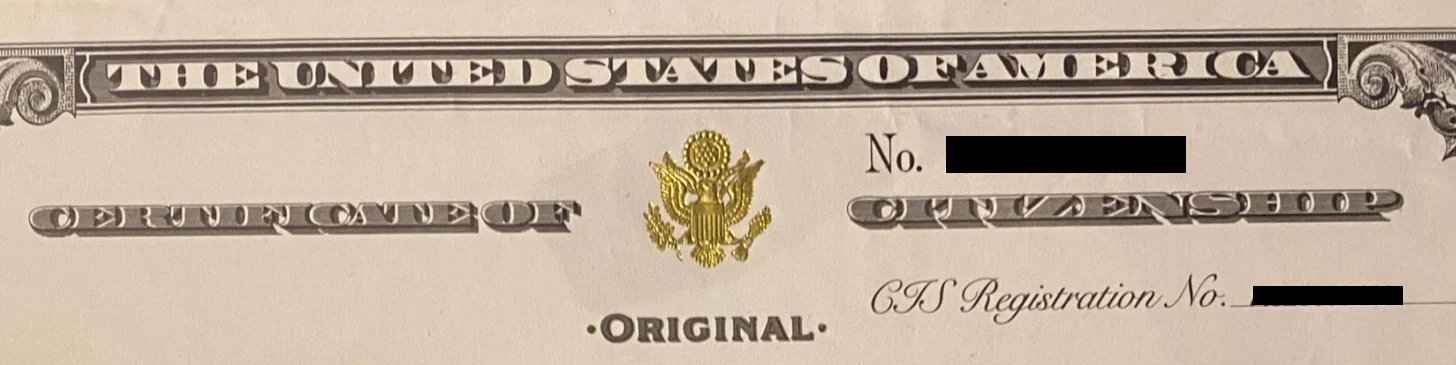
When my father was eight, his mother naturalized as a U.S. citizen. He acquired U.S. citizenship derivatively through her and received his own U.S. Certificate of Citizenship. That date and the way he acquired U.S. citizenship would become important facts to document decades later.
At some point in adulthood, my father had been told that he was no longer German. His childhood German passport was long gone, and he had never been issued a German citizenship certificate. For roughly 40 years there was little reason for him to question what he had been told.
When I began researching the issue, I was not starting with a neat folder that proved everything. I was starting with a family story stretching from Sickerode to Aachen, Hanau and the United States — and one major question: had my father actually lost German citizenship, or had everyone simply assumed that he had?
Answering that question became a months-long records project across Germany and the United States.
The archive came before the appointments
We collected certified German civil records from multiple cities, including my father's German birth registration, my grandmother's records, her marriage record and records from the generation before her. We also obtained U.S. immigration and citizenship material, including my grandmother's A-File, so we could understand the cross-border timeline rather than rely on family memory.
One especially useful record came from Hanau: a historical family Meldekarte from 1960. Hanau located it on microfilm, but access was delayed because the microfilm reader was not working. Eventually the office was able to print the record, certify it and send the physical copy to us.
Certificate of Citizenship vs. Certificate of Naturalization
One terminology point mattered throughout the research: my father's U.S. document and my grandmother's U.S. document were not the same thing. My grandmother became a U.S. citizen through naturalization, so her record says Certificate of Naturalization. My father acquired U.S. citizenship derivatively as a child, and his document says Certificate of Citizenship.

The order we used
My father's first German passport
We started with the generation whose citizenship was the foundation for the rest of us. He went through the direct passport route in Washington and was successful without first obtaining a German citizenship certificate.
My first German passport
After my father had his current German passport, I applied based on descent through him. I brought my own U.S. records plus the parental and German documents the consulate had asked for in my case.
My children's first passports
After I had my passport, we applied for our U.S.-born children's first German passports. Both parents attended. Our children did not yet have U.S. passports, and Washington accepted their applications in our case.
My brother's first passport
My brother then applied through the same family line. He forgot his U.S. passport; Washington allowed him to email a PDF afterward in his particular case. I would never plan on that exception.
My German birth registration
Only after the passport sequence did I go back to register my U.S. birth in a German birth register. That appointment became its own separate records and jurisdiction story.
My own first-passport document stack
For my first passport, Washington wanted to know how I acquired German citizenship. My answer was by descent through my father. The documents I brought for my case included my long-form U.S. birth certificate, U.S. passport, completed application, passport photos, my father's certified German birth-register record, his U.S. Certificate of Citizenship, his German and U.S. passports, and my parents' certified marriage certificate.
Then came the kids—and the passport photos
For the children's first passports we had both parents present, long-form birth certificates, our marriage certificate, completed applications and the parents' passports. I had my German and U.S. passports; my wife had her U.S. passport. Our children did not yet have U.S. passports.
I also took their German passport photos at home. I shot several versions of each child, printed multiple options uncut, and physically checked the print dimensions before bringing them with us. The Embassy also had a $5 passport-photo booth during our visit, which was a good fallback.
The birth-registration appointment was a different chapter
At my later birth-registration appointment, the employee initially assumed the application would go through Standesamt I in Berlin and discussed a roughly three-to-four-year wait. I had already contacted Hanau, though, and had printed email correspondence showing that Hanau had agreed to handle the application with my father acting as the applicant.
I showed the correspondence, the certified Hanau Meldekarte and the other supporting records. The employee asked to keep copies of the Hanau emails with the submission and told me the local processing estimate was roughly three months.
Knowing the Meldekarte mattered at the counter
The Hanau Meldekarte listed both my grandmother and my father. During the appointment, the employee first read it as though only my grandmother appeared. I pointed out my father's entry; she looked again and agreed.
She also initially thought the record was not certified. I knew the certification was on the reverse. Once she turned it over, the Standesamt stamp/signature was there.
My wife's older Soviet documents were reviewed too
During the birth-registration appointment I also showed my wife's Soviet-era birth documentation. The employee asked whether we had an English translation. We did; it dated from 2006, and she said its age was fine for what she was reviewing. She also asked about my wife's U.S. naturalization and whether she held other passports, and we had her U.S. passport and Naturalization Certificate.
We did not use apostilles for these U.S. appointment submissions
None of the U.S. records we used in these Washington passport applications had apostilles, and I also submitted the birth-registration package without first obtaining apostilles. I would not turn our result into a rule that another applicant will never be asked for one. German authorities can request additional authentication depending on the procedure and record.
One payment problem I would prepare for next time
On one consular visit, my Visa bank debit card was declined. That would normally have been easy to investigate, except my phone was locked outside the waiting room and I could not receive or approve a bank fraud notification. Someone with me had another payment method that went through.
What I would do exactly the same way again
- Start with the oldest generation whose status drives the rest of the family case.
- Get certified German records directly from the issuing authority when possible.
- Build the family timeline from records, not memory.
- Know what each document proves and where the important entry appears.
- Contact the likely Standesamt before a birth-registration appointment when jurisdiction is not obvious.
- Print important email correspondence and bring it.
- Bring more than one payment method.
- Bring relevant extras, but keep the core required documents easy to find.
What our experience does not prove
If you're building a similar paper trail
The technical guides below show the individual pieces without forcing you to reconstruct them from this story.
Official sources
- German Missions — obtaining German citizenship / citizenship by descent
- German Missions — passport for adults
- German Missions — passport for applicants under 18
- German Missions — registration of a foreign birth
This article describes our family's own sequence and appointments. It is records-and-process information, not a legal eligibility opinion. Requirements can change and the responsible German authority controls each individual case.