We successfully requested certified historical birth-register records from German local authorities by email. The examples below describe our experience; each municipality controls its own ordering process and fees.
1. Find the office that holds the record
For a civil-status record, start with the municipality where the birth, marriage or death was registered. Search the official municipal site for Standesamt, Geburtsurkunde, Personenstandsurkunden or beglaubigte Abschrift aus dem Geburtenregister. If an older register has transferred to an archive, the municipality or archive can often redirect you.
2. Ask for the record precisely
In citizenship research, a simple modern certificate is not always the only useful format. In our requests we specifically asked about a beglaubigte Abschrift aus dem Geburtenregister because register annotations can matter for events such as adoption or later name changes.
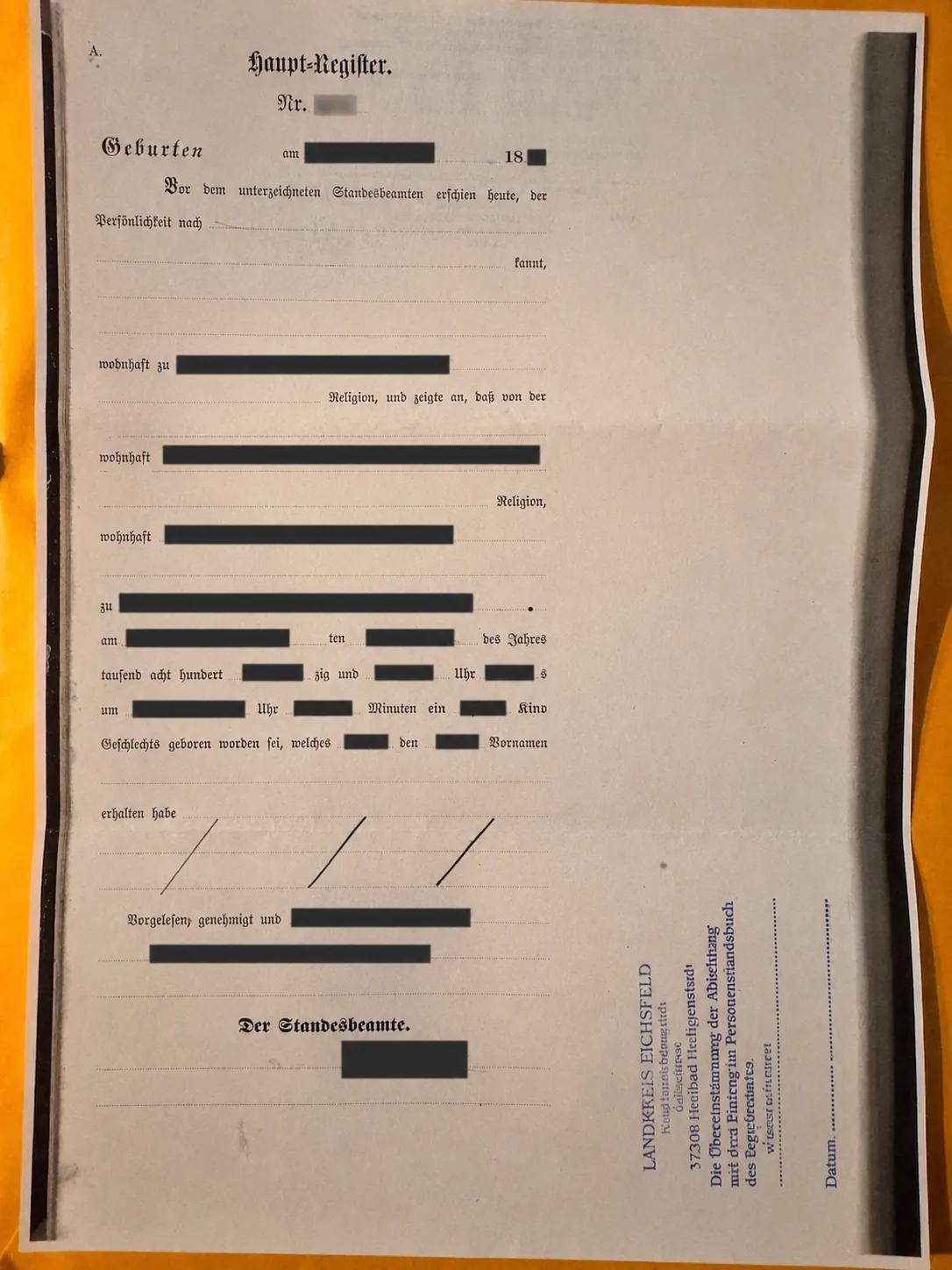
A redacted historical register page we received from a German authority. Personal names, dates and identifying details are concealed.
Who probably has the record?
German civil registers do not stay with the Standesamt forever. Under the current Personenstandsgesetz, the register-maintenance periods are 110 years for birth registers, 80 years for marriage and civil-partnership registers, and 30 years for death registers (with a special longer rule for the death register of the Special Registry Office in Bad Arolsen). After the applicable period expires, archival law governs access. That is why an older request may be redirected from the Standesamt to a municipal or regional archive.
Who can usually request a certificate?
Under the current Personenstandsgesetz, certificates can generally be issued to the person named in the register entry, that person's spouse or life partner, and direct ancestors or descendants. Other people generally need to establish the required legal interest; siblings requesting a birth or death record have a somewhat different statutory standard. Special cases can have additional restrictions, so the responsible office still controls the individual request. That is one reason our emails clearly explained the family relationship and purpose.
3. Give the office enough to find the person
Our emails included the person's name at birth, date and place of birth, relevant parents or later names, our relationship to the person, and supporting records when they helped explain the family line or a name change.
4. Ask about fees and payment from the U.S.
Rather than assuming a price, we asked the office to tell us the current fee and payment method. Several offices supplied an amount and German bank details. We then paid from the United States and sent proof of payment back by email.
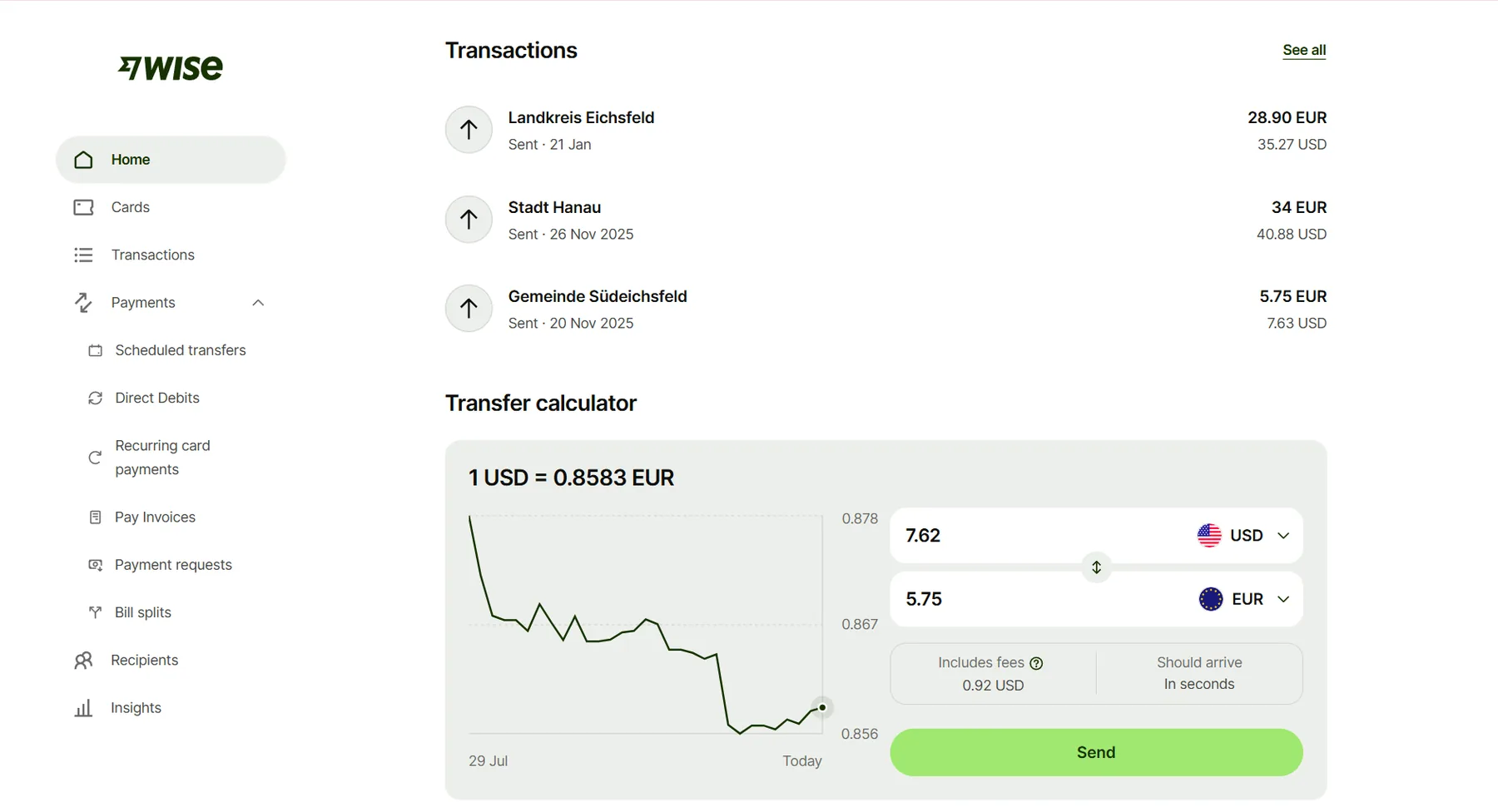
Our Wise transaction history shows several real euro payments to German local authorities. Exchange rates and fees change; this screenshot is an example, not a price quote.
We used Wise for at least three or four different German Standesämter/local authorities during this project and had no issues with those payments. It let us review recipient details before sending and produced a receipt plus a shareable payment-status link that we could email back to the office. Wise is not required—follow the payment instructions from the authority.
If you want the broader workflow, see How We Use Wise for International Payments From the U.S..
Visit Wise →If an office sends you bank details
- Use the recipient name, IBAN and payment reference exactly as supplied.
- Double-check the reference line before you send the payment.
- Save the receipt and send it back if the office asks for proof.
- If the matter is time-sensitive, politely tell the office after you have paid.
5. If you have a deadline, politely ask about a scan
In one request we explained that a consular appointment was approaching and asked whether a digital scan could be sent if international mail was delayed. The office emailed a scan and mailed the original. Whether a scan is acceptable for your own procedure is a separate question for the receiving authority.
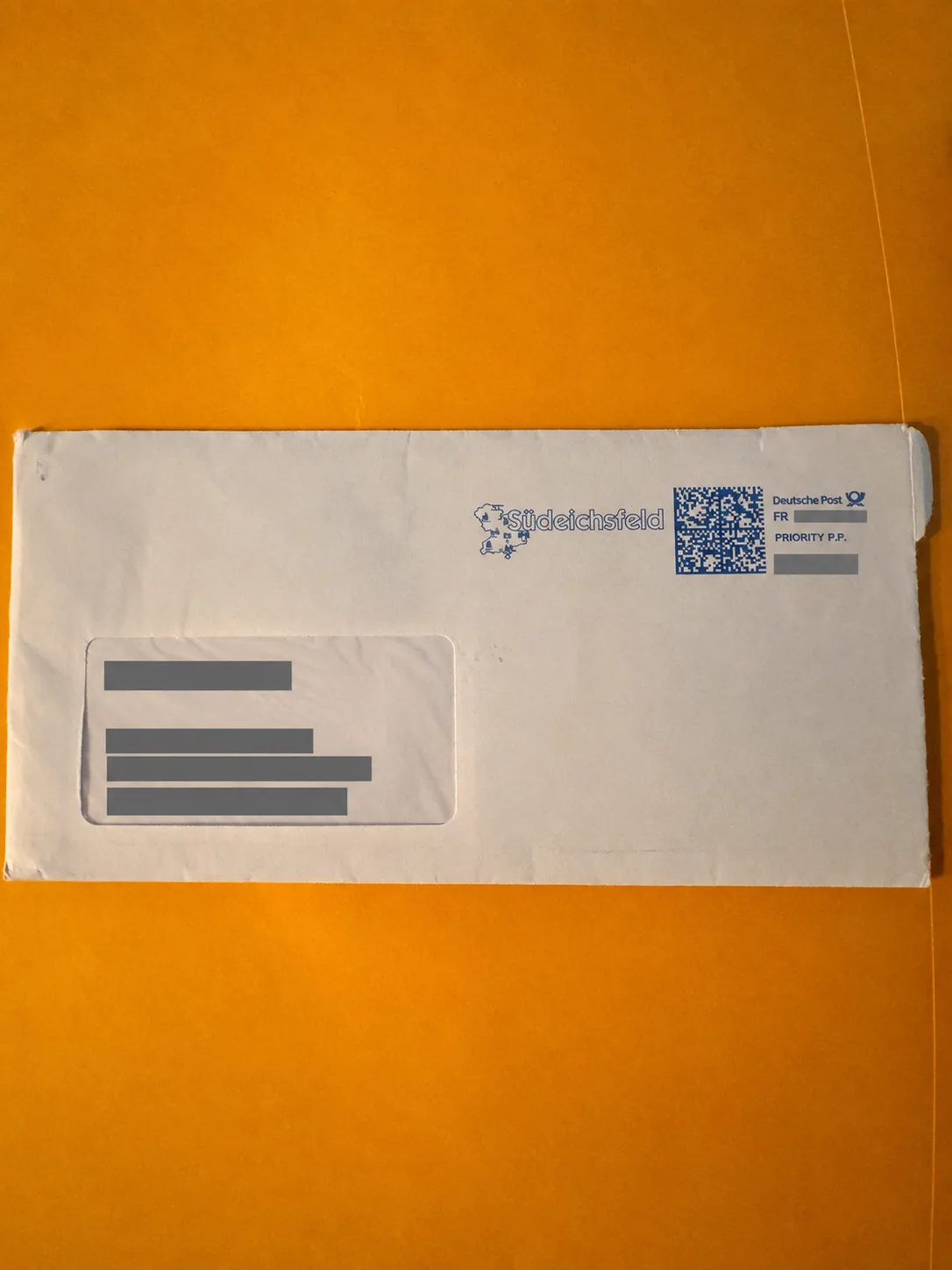
A real municipal mailing received in the U.S. We conceal the recipient information and machine identifiers before publication.
What surprised us
An office may not be able to create the exact document configuration you imagine. In one case we asked about two different versions of the same birth record, but the registrar explained what the office could actually issue. Explain what you are trying to obtain and let the office tell you which official record format exists.
When we couldn't read the handwritten side notes
A historical birth-register copy can contain much more than the main birth entry. Handwritten Randvermerke (marginal notes) may include formal Folgebeurkundungen (later official entries), Hinweise (references to related records), and older pencil notes. These terms are not interchangeable: the German civil-register law distinguishes the main entry, later entries and references. On older paper records, later entries may appear in the margin while references may appear below the entry. See § 3 PStG and § 66 PStV.
We received a certified birth-register copy, but some handwritten annotations along the side were so faint that we could not reliably read them. We emailed the issuing Standesamt, thanked the registrar, and asked either for a clearer copy or for the exact wording of the notes by email. The registrar replied with a written explanation of the pencil notes and a later entry that pointed to a child's birth recorded by a different Standesamt. This gave us a precise lead to follow instead of guessing from the scan.
In a separate request, we could not confidently read a relative's mother's maiden name in old German handwriting (Kurrent). We politely asked the Standesamt whether our reading was correct. The registrar agreed with the reading and also located details of our relative's death, telling us where the death register was held. We had asked for a clarification, but received a useful lead for the next record too.
What to include in a useful follow-up
- Identify the record precisely: full name, event date, Standesamt and register number if you have one.
- Point to the unclear text, such as “upper left margin” or “the note below the main entry.” A cropped image can help, if appropriate.
- Ask for a clearer copy or a written transcription; for a name, state your tentative reading and ask whether it is correct.
- If a note names another register, ask which office holds it and how to request a copy.
Translations: don't pay before you check
German Missions in the U.S. currently state that translations of English-language documents are generally not necessary in citizenship matters. Requirements can vary by procedure or authority, so confirm before paying for a translation.
October 2026 follow-up: the Embassy checked the certification
We later used one of our certified German birth-register records during a birth-registration appointment at the German Embassy in Washington. The official Standesamt stamp/signature was on the reverse, and the consular employee actually turned the record over to verify that certification.
That is why we now distinguish between a scan that helps you research and an officially certified record intended for formal use.
During the same appointment, I mentioned that I had paid Hanau through Wise. The employee said it was a very good choice for this kind of payment and commented positively on the fees, particularly for someone paying from the U.S. without a German bank account. That was a positive comment from one employee, not an official German-government endorsement; always follow the recipient authority's payment instructions.
Official sources
- German Missions in the United States — Citizenship
- German Missions — Citizenship FAQ
- Personenstandsgesetz (PStG) § 5 — Register maintenance periods
- Personenstandsgesetz (PStG) § 62 — Certificates, information and access
- Personenstandsgesetz (PStG) § 3 — Main entries, later entries and references
- Personenstandsverordnung (PStV) § 66 — Notes on older paper registers
Government procedures change. We verify procedural claims against official sources and label our own experience separately. The receiving German authority controls what is required in an individual case. This page describes procedure and our experience; it is not legal advice.