Our request covered four historical Vågå parish-register entries in the same family line. We supplied exact source references and Digitalarkivet links, asked for visible Arkivverket certification, and asked for paper copies mailed to the United States.
1. Find the record before asking the archive to find it
The strongest part of our request was that we had already done the search. Instead of sending only an ancestor's name, we provided the parish, event, date, source book and Digitalarkivet reference for each entry.
That makes the request easier to understand and reduces ambiguity when the same names appear repeatedly.
2. Our redacted Arkivverket request
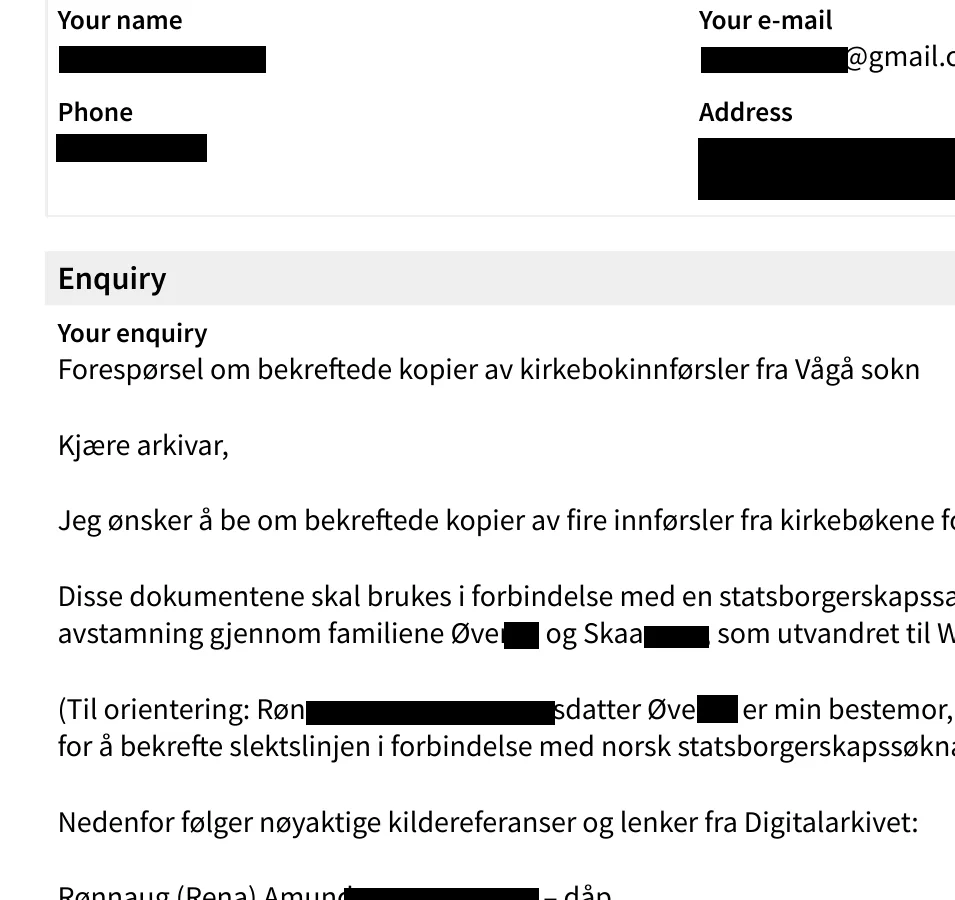
A flattened, redacted image from our actual request. Current contact information and identifying details are not published.
The request explained the purpose, then listed the relevant historical entries with dates and source references. We also asked Arkivverket to tell us about any fee or postage that needed to be paid in advance.
Information we included
- Parish / location
- Full historical name as found
- Event type: baptism, marriage, etc.
- Date of the event
- Parents or spouse when useful
- Church book / source reference
- Digitalarkivet link
- What form of certified copy we were asking for
- International mailing destination
3. A simpler request template
This is a cleaned-up example based on the structure that worked for us. It is not an official Arkivverket form and should be adapted to your own record and purpose.
Show English translation
4. What the certified document looked like
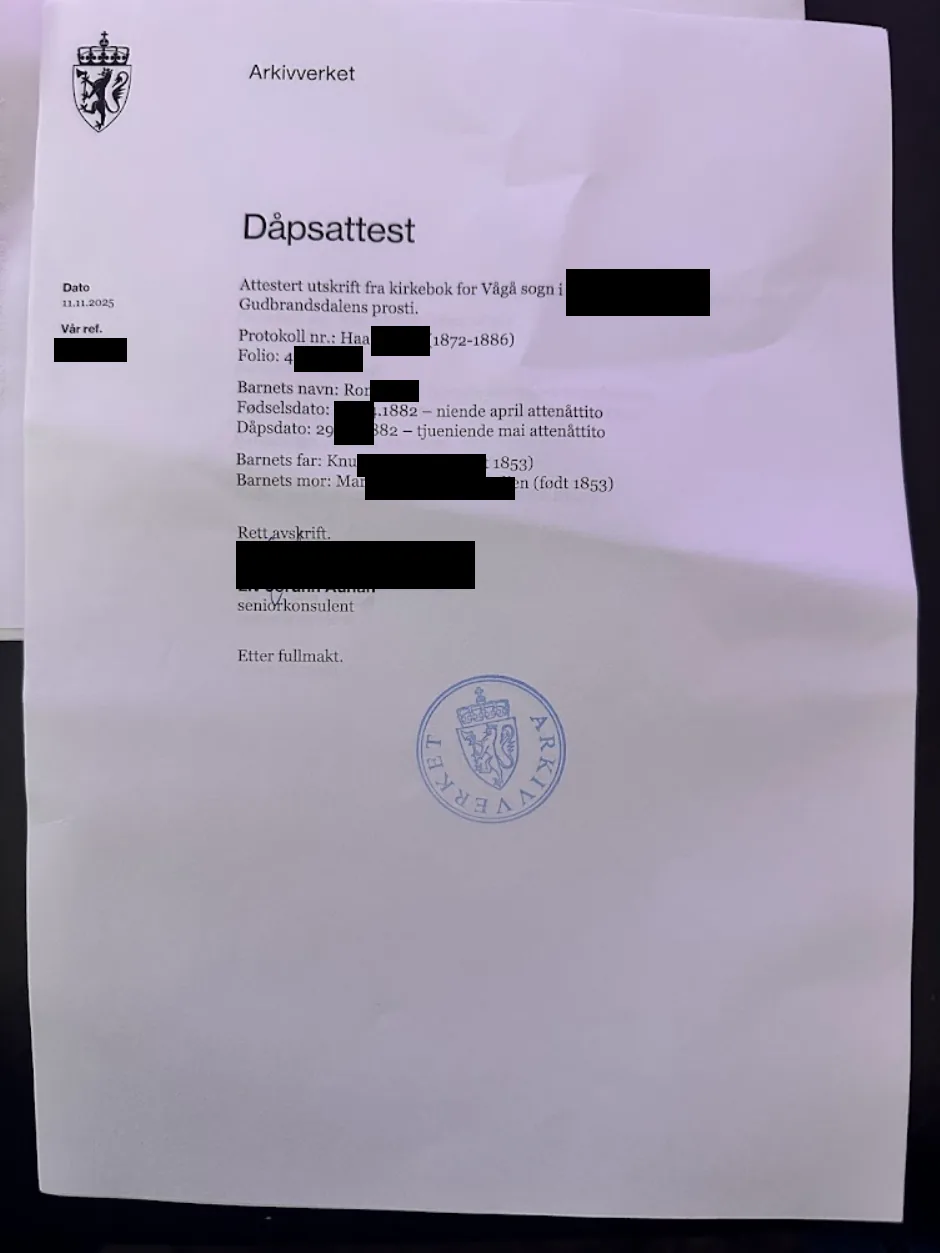
One of the certified documents we received. The public image is flattened and redacted; the original paper record remains unchanged in our files.
The important distinction is that this is not merely a screenshot from a genealogy database. It is documentation issued by Arkivverket from the underlying church-book source and visibly certified by the archive.
5. The records arrived from Norway by mail
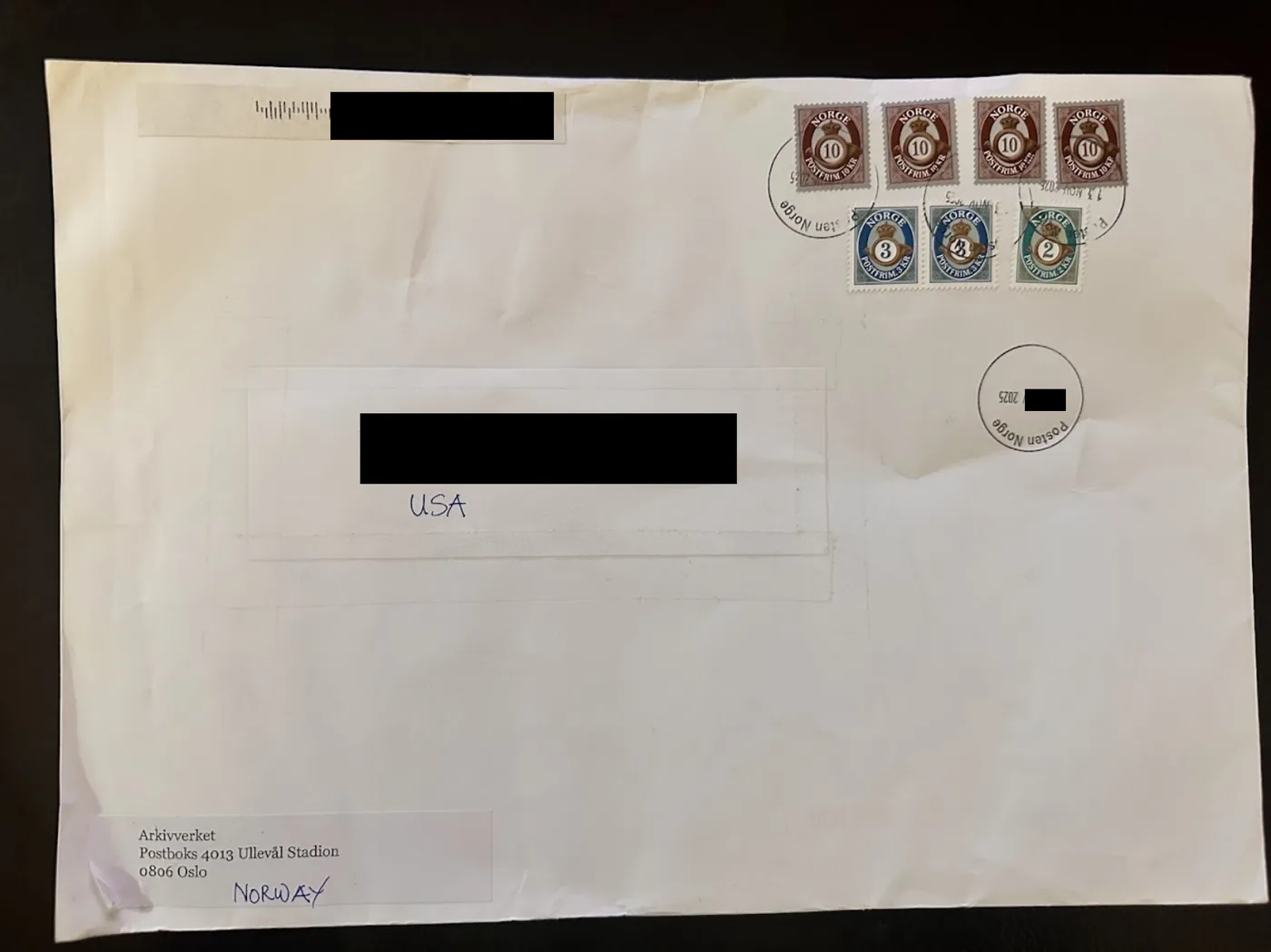
The Arkivverket mailing we received in the U.S. The current recipient address is redacted before publication.
Our request specifically asked for paper copies sent internationally. We recommend keeping the envelope with the documents until you know whether provenance, mailing details or an original physical record matters for your later use.
6. Ask about fees instead of guessing
In our request we asked Arkivverket to tell us about any fee or postage that needed to be paid in advance and stated that we could pay from the U.S. if necessary. We would not publish a fixed fee here because costs and procedures can change—and a particular request may be handled differently depending on what is being ordered.
If an archive sends you international bank details, our separate Wise international-payments guide shows the payment workflow we have used for overseas transfers. That does not mean Wise is required or that Arkivverket will use that payment method for every request.
7. Keep the certified original separate from research copies
We scan and organize research copies, but the paper original stays protected. If you are building a citizenship or legal-document packet, keep track of which file is a downloaded scan, which is your own photocopy, and which is the certified original issued by the archive.
Official sources
- Digitalarkivet — Detailed person search
- Arkivverket — Parish registers
- Arkivverket — Tracing your ancestry
This page documents what worked in our request. It is not a promise that every archive request will be handled the same way, and it does not determine what another authority will accept.