We used this workflow on our own Vågå family line. The screenshots and documents on this page come from that research. Where we discuss what a source can contain, we cross-check against Arkivverket's current guidance.
1. Start with what you know in America
Norway's own genealogy guidance makes an important point: to use Norwegian sources well, you generally need a Norwegian-born person's name and birthplace first. In practice, that means U.S. census, naturalization, immigration, obituary, cemetery or family records can be the clue that gets you back across the Atlantic.
For our line, the goal was not to build a tree from guesses. It was to identify the correct people, place them in Vågå, and then verify them against the original Norwegian records.
2. Search Digitalarkivet
We used Digitalarkivet's detailed person search to combine names, approximate years, birthplace, residence and related-person clues. Name variants matter: nineteenth-century Norwegian spelling was not standardized, and patronymics plus farm names can change how the same person appears from one record to another.
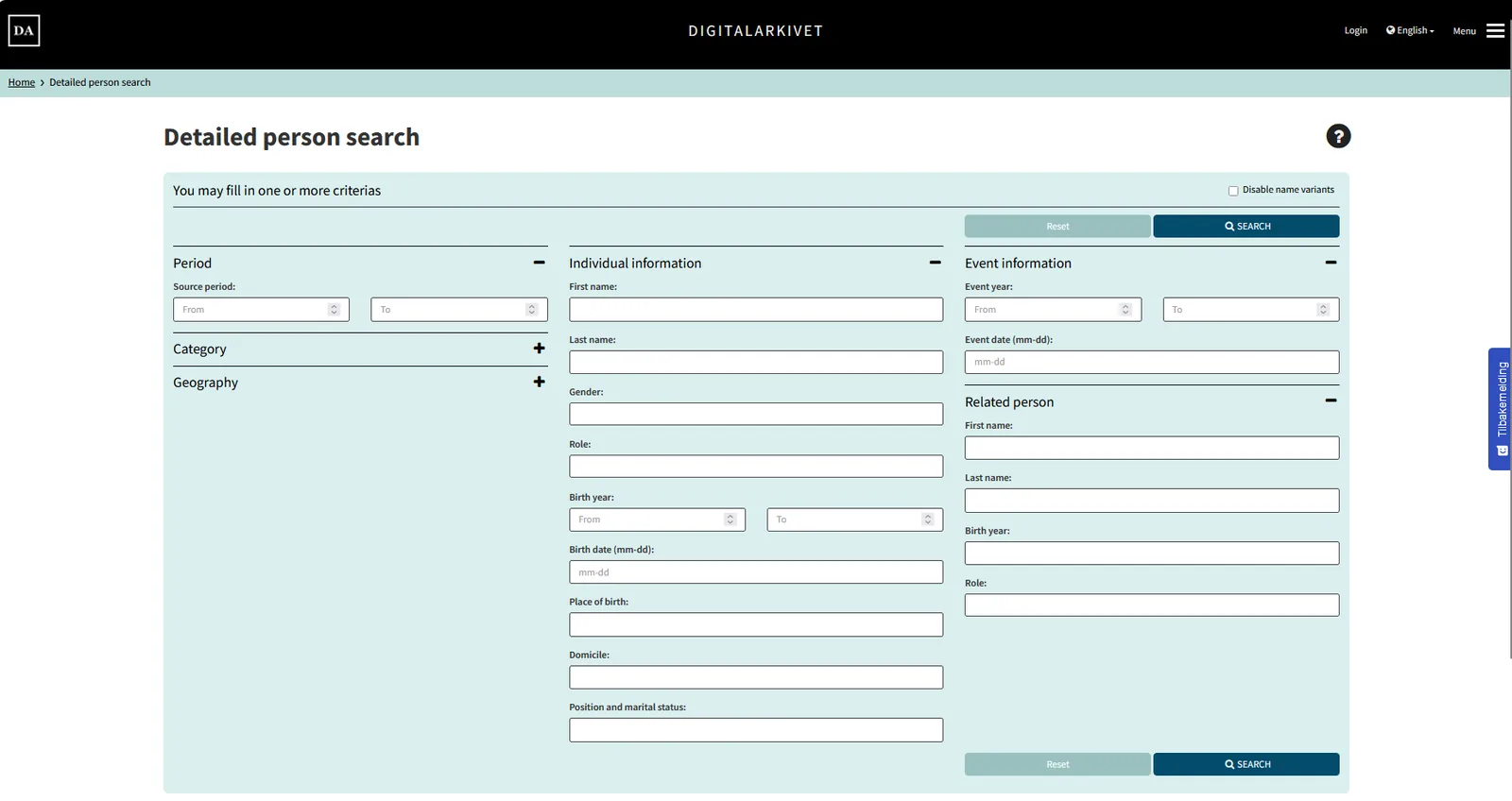
Screenshot: Digitalarkivet/Arkivverket. This is the detailed-person search we used. Start broad enough to catch spelling and name variants, then narrow with dates, places or relatives.
What made the search work better
- Approximate birth year rather than insisting on one exact date
- Place or parish when known
- Parents or spouse as related-person clues
- Testing alternate spellings and patronymics
- Opening the actual source rather than stopping at the search-result transcription
3. Open the original church-book page
An index result is useful, but the scanned parish register is the stronger research source. Arkivverket describes parish registers as first-hand genealogy sources and notes that they can include parents, homesteads, godparents or witnesses. In our case, opening the original pages gave us the archive provenance we later needed for the certified-copy request.
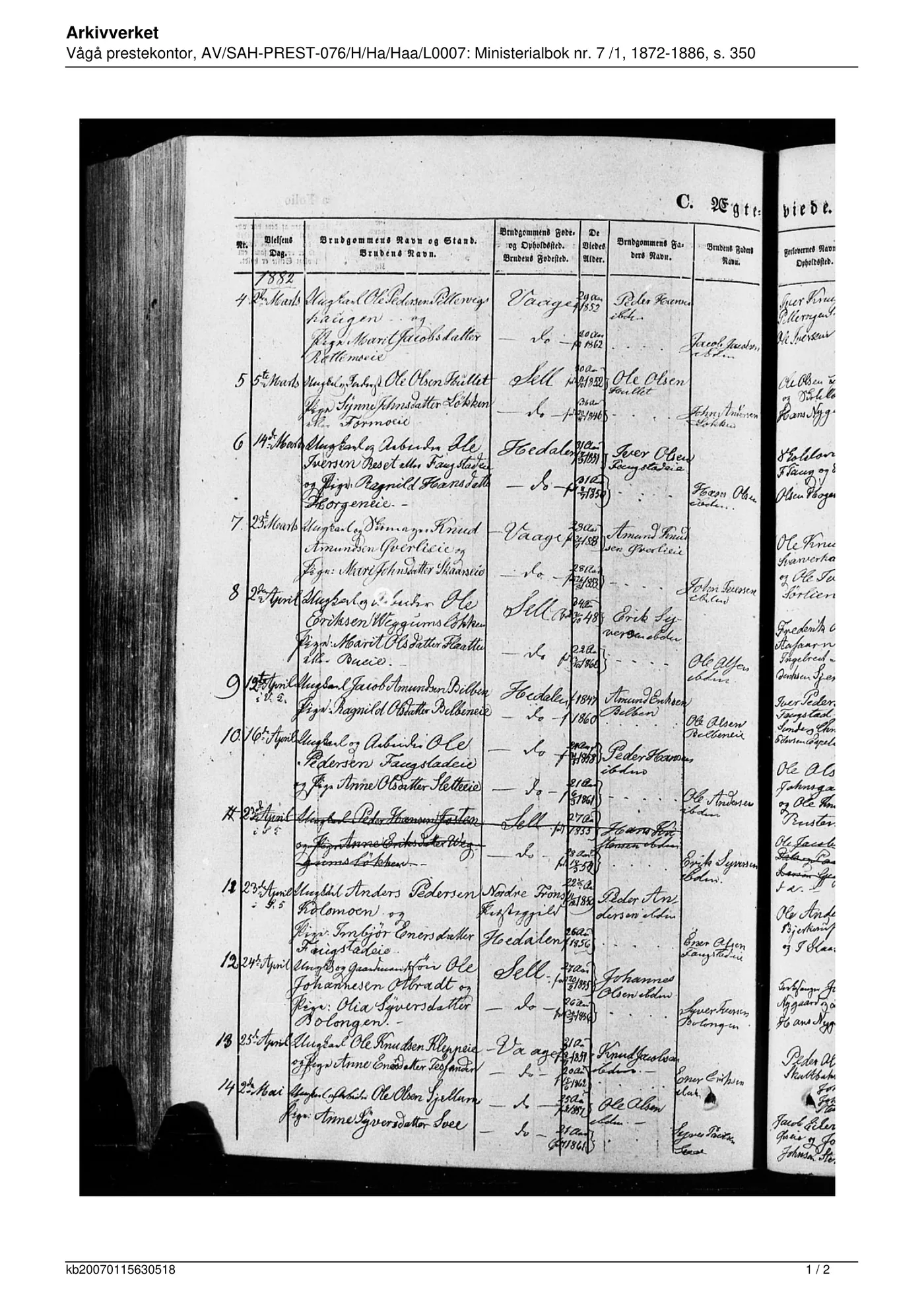
A digitized Vågå church-book page from our research. We recorded the parish, book, page and Digitalarkivet reference instead of saving only a name/date transcription.
Record the source trail
- Parish / parish office
- Register or ministerial book
- Date range
- Page or image reference
- Permanent Digitalarkivet/media link when available
4. Treat farm names as research clues, not fixed surnames
Arkivverket's Norwegian-American genealogy guidance explains that a typical nineteenth-century Norwegian name could include a given name, patronymic and farm name—and that the farm name functioned more like an address than a modern hereditary surname. If someone moved, the farm-name element could change.
That matters when following a person across baptism, marriage, census and emigration records. A changed farm name is not automatically a different person; it can be another clue to residence.
5. Use Norwegian censuses to place the household in time
Arkivverket notes that historical Norwegian censuses are available online in Digitalarkivet. Censuses can help connect a church-book event to a household, residence, age, occupation and family group at a particular moment.
This is also where we would verify claims that are otherwise tempting to overstate—such as whether someone was recorded as a farmer, farm laborer, servant or tenant.
6. When the old place name stalled us, we asked Vågå Historielag
In July 2026, our 1882 marriage record used the residence spelling Øverlieie, while the baptism record for the couple's daughter used Øverlien. Those names were valuable clues, but they were not enough for us to responsibly identify a modern property on our own.
Instead of guessing, we contacted Vågå Historielag, the local historical society. We gave them the names and dates, explained the two place-name spellings, identified the parents, and attached the historical marriage and baptism records we had already obtained.
Show English translation
Show English translation
That reply gave us the missing bridge: the old residence wording in the church records could be followed into the local farm history under Lauvrusten/Løvrusten.
We also asked whether the property stayed in the family
Show English translation
Show English translation
The reply pointed us back to the published Lauvrusten history and said that Iver Amundsen took over in 1894 and that descendants succeeded him later. We do not publish the researcher's speculation about a present-day living owner. Current ownership should be verified from the appropriate current property record, not inferred from a genealogy email.
What the published local farm history let us verify
7. Map the identified holding with Kartverket
Once Vågå Historielag had identified the historical place and its published farm history gave us the modern identifier gnr. 161, bnr. 4, the map search became much more defensible. Kartverket explains that municipality, gårdsnummer and bruksnummer are used to uniquely identify Norwegian properties. We then used the official property/map tools to place Lauvrusten/Løvrusten in today's landscape.
How we searched the modern map
- Open Kartverket's Eiendomsregisteret.
- Search using the municipality and cadastral identity rather than guessing from the historical spelling.
- For this case, use Vågå — gnr. 161 — bnr. 4.
- Open the matching property, then use Norgeskart for wider topographic context.
The modern cadastral result helps locate the holding today. It does not by itself prove who lived there, occupied it or owned it in a particular year in the 1800s; that still comes from the historical records.
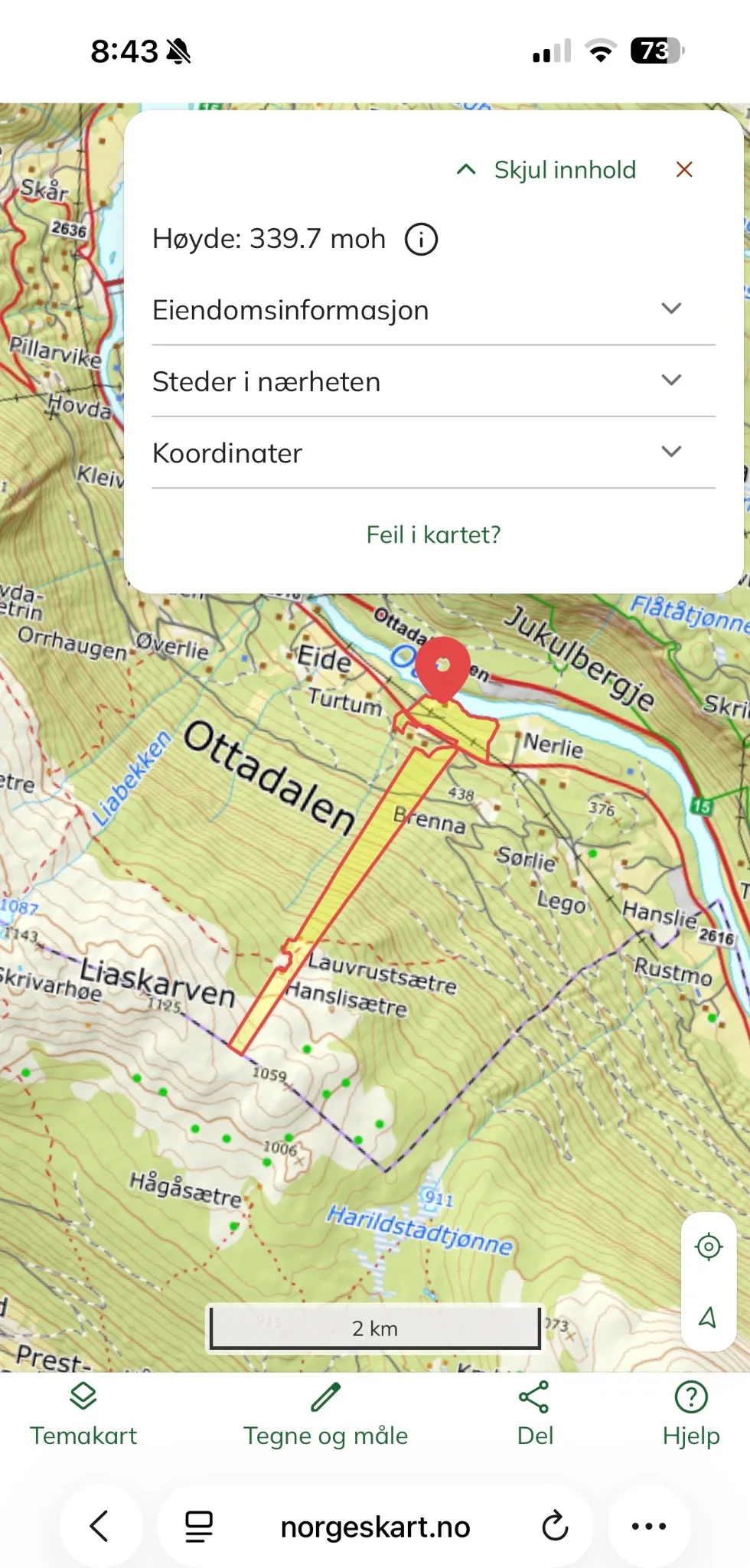
Screenshot: Kartverket/Norgeskart from our research. The map helped us place Lauvrusten/Løvrusten in the modern landscape after the historical society and farm history identified the holding. We intentionally do not publish current owner information or a private residential address.
8. Follow the family forward into U.S. records
Once the family emigrated, the research job changed. Norwegian parish books could document the family before departure, while American censuses, naturalization files, land records and other local records could show where they settled and how later generations developed.
We would not publish a specific transatlantic route, ship, occupation or land-ownership story until we have the exact source that proves it. The value is in showing readers how to move from one documentary system to the next without filling gaps with a plausible story.
9. When the online image is not enough
For an official matter, we wanted more than a screenshot. After identifying the exact church-book entries and archive references, we submitted a request to Arkivverket for certified paper copies. That process is documented separately because it is a different task from genealogy research.
Sources used
- Digitalarkivet — Detailed person search
- Arkivverket — Tracing your ancestry
- Arkivverket — Parish registers
- Kartverket — Find gårds- og bruksnummer
- Kartverket — Eiendomsregisteret guidance
- Vågå Historielag — Sørlien og Nerlien, gnr. 161 (local farm history, July 2026)
Digitalarkivet/Arkivverket and Kartverket are official Norwegian sources. Vågå Historielag is a local historical society whose published farm history helped interpret the old place name. We use the modern map as a location tool, not as proof of nineteenth-century ownership.